

How to Choose the Right Rods and Reels for Lake Erie Fishing
Our Top Picks
Affiliate disclosure: if you buy through these links, we may earn a commission at no extra cost to you.

Your rod and reel setup is the foundation of everything that happens on the water. Pick wrong, and you'll spend the season fighting your gear instead of walleye, perch, and bass. Pick right, and you'll land more fish, stay comfortable through brutal conditions, and have equipment that performs when it matters most—whether you're drifting the Central Basin in July or chasing fall walleye in deeper water off Catawba Island.
Lake Erie demands gear that handles cold freshwater, rapid current changes, and the kind of sustained pressure that comes from back-to-back fish. This guide walks you through exactly what to look for, what works for each species and season, and which setups have proven themselves over years of tournament fishing and daily charter runs.
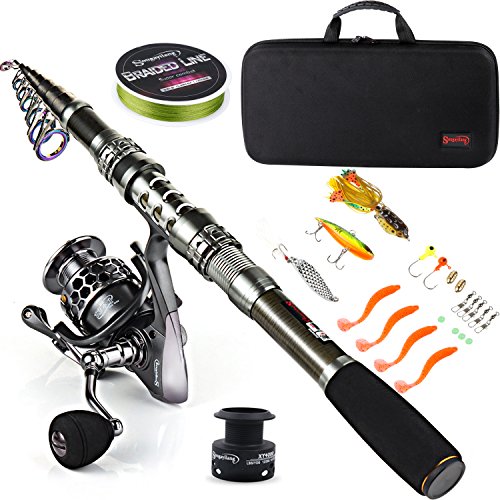
Ghosthorn Fishing Rod and Reel Combo Telescopic Pole Kit Plier Portable Travel Kit with Carrier Bag for Freshwater Saltwater
$71.39Check Price
Table of Contents
Understanding Lake Erie Conditions and Rod Requirements
Lake Erie isn't the ocean, but it demands respect. You're working in fresh, cold water that corrodes differently than salt, with variable depth from 25 feet in the Western Basin to 210 feet in the Central Basin. Wind changes direction fast. Current intensifies during spring runoff and fall cooling. Your rod and reel system needs to handle sustained use without freezing up, respond accurately in cold water where reels slow down, and maintain balance when you're casting or jigging for eight to ten hours straight.
The Western Basin—shallower, murkier, warmer in summer—plays to different strengths than the Central Basin where you're working deeper structure and stronger current. Western Basin fishing favors slightly lighter action for sensitivity when jigging in 20 to 35 feet of water. Central Basin work, especially fall walleye in 50 to 80 feet, demands stiffer rods that transmit bottom feel clearly and allow you to maintain precise depth control in heavy wind.
Cold water also thickens lubricant in your reel. A reel that feels smooth at 70 degrees becomes sluggish at 35 degrees. You need quality sealed reels with proper cold-water grease, not standard drag fluid that hardens when the air temperature drops. This isn't luxury—it's function.
Rod Length, Power, and Action: The Core Factors
Rod length on Lake Erie typically ranges from 5 feet 6 inches to 7 feet, depending on your technique and position in the boat. Shorter rods (5'6" to 6') give you control when you're fishing vertically—jigging walleye in tight structure or working perch schools where precision matters more than distance. Longer rods (6'6" to 7') are standard for casting and trolling situations where you need line control and can benefit from the leverage on the hook set.
Power refers to how much force the rod needs to load properly. Light power rods bend easily and work well for perch jigging with 1/8-ounce to 1/4-ounce jigs. Medium power rods—the workhorse of Lake Erie—handle everything from walleye crankbait trolling to casting for bass and working jigs from 1/4-ounce to 5/8-ounce. Medium-heavy power rods are your tool when you're working heavy jigs (3/4-ounce or more) in deep water or fishing dense vegetation where you need solid backbone to drive the hook through. Heavy power rods on Lake Erie are niche—ice fishing and specialized deep-water jigging mostly.
Action describes where the rod bends. Fast-action rods bend primarily near the tip, giving you sensitivity and quick hook sets but less forgiveness on light line. Medium-action rods bend from mid-shaft to tip, offering better balance between feel and flexibility—ideal for walleye trolling and perch fishing where you want responsiveness without line breakoffs on lighter test. Slow-action rods bend progressively throughout the entire length, absorbing shock and protecting light line. Lake Erie walleye often demands this quality, especially in fall when you're running 6-pound fluorocarbon and fighting 4-pound fish in current.
Reel Selection for Walleye, Perch, and Bass
Spinning reels dominate Lake Erie fishing for good reason. They're forgiving with lighter line, easier to operate in cold weather when your hands are numb, and require less maintenance than baitcasters in a freshwater environment that deposits silt and debris constantly. Your reel needs a sealed drag system, a smooth retrieve, and a spool capacity that matches your line weight and fishing style. Walleye and perch fishing uses 8- to 10-pound braid or 6- to 8-pound fluorocarbon. Bass fishing might run 8- to 12-pound mono or braid.
Look for reels in the 2500 to 3000 size for walleye and perch. A 2500 holds about 200 yards of 8-pound braid, which is plenty for the depths and casting distances on Lake Erie. These smaller reels also reduce fatigue on long days—arm and wrist strain is real when you're fishing 10 hours. Bass fishing can run slightly larger (3000 to 4000) because you're often working thicker cover and casting heavier baits, but most anglers fishing Lake Erie bass stay with the 3000 size for balance and control.
Drag smoothness matters more than drag maximum. Lake Erie walleye in fall run 2 to 4 pounds mostly—you need a drag that releases consistently at 1 to 1.5 pounds without stick-slip. Test the drag by hand before you buy. Turn the handle slowly and feel the drag resistance. It should feel perfectly uniform, not catching or hesitating. Stick-slip drag (where the drag releases in pulses instead of smoothly) will cost you fish when they run in open water. The sealed drag protects internal components from the sediment and temperature swings that Lake Erie throws at you.
Retrieve ratio should be 5.2:1 to 5.5:1 for walleye and perch—this pace lets you work jigs at a natural rhythm and keep up with moderate trolling speeds. Bass can go slightly faster (5.7:1 to 6.2:1) if you're working cover actively, but the difference isn't critical. What matters is that the reel winds smoothly at that pace without vibration in your hand, which signals bearing wear or internal damage.
Matching Your Setup to Season and Technique
Spring (April-May) walleye fishing in the Western Basin calls for lighter sensitivity. Spawn fish are in shallow water—15 to 30 feet—feeding aggressively but also easily spooked. Use a 6-foot medium-power rod with a 2500 reel and 6-pound fluorocarbon. The setup's lighter feel lets you detect subtle bites on live minnows or small crankbaits. Trolling speed is slow (0.8 to 1.2 mph) and you're following structure, not making long casts, so the shorter rod gives you better contact with the bottom.
Summer (June-August) perch fishing explodes in the Central Basin where you're working 30 to 50 feet. This is vertical jigging territory. A 5'6" to 6-foot light to medium-power rod with a 2500 spinning reel works perfectly. Perch respond to 1/8-ounce to 1/4-ounce jigs tipped with small minnows or shiners. Your reel should turn smoothly and retrieve line quickly (5.3:1 minimum) so you can move through the water column and cover depth zones fast. Eight-pound braid lets you feel bottom perfectly in the deeper structure where perch hold during the day.
Fall (September-November) walleye fishing shifts deeper and demands more precision. You're working 50 to 80 feet in the Central Basin, often in strong current. A 6'6" medium-power, medium-action rod with a 3000 reel and 8-pound braid (main line) plus 6-pound fluorocarbon leader gives you the sensitivity to feel bottom changes and the backbone to work heavy jigs (1/2-ounce to 3/4-ounce) methodically. Fall walleye bite harder but also run harder in colder water, so your reel's drag becomes critical—any hesitation costs fish.
Bass fishing (year-round, peaks July-October) in weed beds and rock structure benefits from a 6'6" to 7-foot medium-heavy rod with a 3000 reel. Bass demand faster responsiveness and harder hook sets than walleye, so a faster action (fast to medium-fast) gives you that immediate connection. Braid (10- to 12-pound) is standard because it cuts through vegetation cleanly and floats slightly, which helps topwater lures perform better in the morning and evening.
Ice Fishing Rods and Specialized Gear
Ice fishing on Lake Erie (January through early March) uses entirely different equipment. You're standing in 15 to 30 feet of water, often in harsh wind, jigging walleye and perch vertically. Ice rods are short—24 to 30 inches—with stiff power and fast action. They're built for precision jig work in confined space. Popular models are ultralight to light power because you're using small jigs (1/32-ounce to 1/4-ounce) and need to feel every tick on the bottom.
Reels for ice fishing are either inline spinners or small baitcasters. Inline spinners sit along the rod and minimize ice buildup. Small baitcasters (narrow spool, 250-yard capacity) give you better line control and accuracy. Either way, the reel must be sealed against ice and snow. Test it before you commit to it—reels that fail at 10 degrees above zero will be worthless at minus-5. Line choice is typically 2- to 4-pound mono or 3- to 6-pound braid. Braid sinks faster and transmits feel better, but mono stretches and sometimes protects against break-offs when ice-cold line becomes brittle.
Jigging motion on Lake Erie ice demands a rod that responds to small hand movements.
Frequently Asked Questions
How do I choose the right rod length for Lake Erie fishing?
Rod length for Lake Erie depends on your target fish and fishing method—walleye and perch typically require 6 to 7-foot rods for better control, while bass fishing often benefits from 6.5 to 7.5-foot rods for casting distance. Shorter rods provide better accuracy in confined spaces, while longer rods allow for longer casts and better line management in open water conditions.
What is the best reel type for walleye fishing on Lake Erie?
Baitcasting reels and spinning reels are both excellent for walleye on Lake Erie, with spinning reels being more beginner-friendly and baitcasters offering superior accuracy and control for experienced anglers. Choose based on your skill level and whether you prioritize ease of use or precision casting.
How do I match rod power to Lake Erie fish species?
Medium power rods work well for perch and smaller walleye, while medium-heavy power rods are better suited for larger walleye and bass that put up stronger fights. Understanding the typical size and fighting strength of your target species ensures your rod can handle the load without tiring you out during long fishing days.
What rod action is best for Lake Erie perch and walleye?
Fast action rods are ideal for detecting subtle bites from walleye and perch, while moderate action rods provide a better balance of sensitivity and flexibility for diverse fishing techniques. Your choice should depend on whether you prioritize bite detection or need more forgiveness when fighting fish.
Is it worth investing in a quality rod and reel for Lake Erie fishing?
Yes, a quality rod and reel setup is essential for Lake Erie fishing because it directly impacts your ability to detect bites, set hooks properly, and land fish successfully throughout the season. Investing in reliable gear prevents frustration and increases your catch rate, making it worthwhile for both casual and serious anglers.
How do I know what reel size I need for Lake Erie conditions?
Reel size should match your rod and line capacity needs—typically a 2500 to 3000 size spinning reel works for walleye and perch, while 3500 to 4000 sizes are better for bass and larger walleye. Check your rod's specifications and the line weight you plan to use to ensure proper balance and adequate line capacity.


