

Budget Spinning Reels vs Premium Reels for Lake Erie Bass Fishing
Budget Spinning Reels vs Premium Reels for Lake Erie Bass Fishing
You're rigging up for bass season on Lake Erie, and your reel is wearing out. The question hits you hard: do you grab a budget spinning reel to replace it, or invest in a premium setup? This decision matters more than most anglers realize. Your reel choice directly impacts casting distance, line management under pressure, and cold-water performance—especially when you're working deep flats in the Central Basin or chasing schoolers in the shallows. Get this wrong, and you'll replace it mid-season. Get it right, and your gear works as hard as you do.
After decades on the water and countless tournaments, I've burned through both budget and premium reels. I've watched anglers win fish on solid budget gear and lose walleye-sized bass because their reel couldn't hold up when conditions turned cold. Here's what actually matters when you're deciding between budget and premium spinning reels for Lake Erie bass.
Table of Contents
- Our Top Picks
- Quick Verdict
- About Budget Spinning Reels
- About Premium Reels for Lake Erie Bass Fishing
- Head-to-Head: Drag Performance Under Cold Water and Load
- Head-to-Head: Bearing Quality and Casting Distance
- Head-to-Head: Maintenance Demands and Actual Cost of Ownership
- Head-to-Head: Spool Design and Line Capacity
- Frequently Asked Questions
Our Top Picks
Affiliate disclosure: if you buy through these links, we may earn a commission at no extra cost to you.


Quick Verdict
Choose Budget Spinning Reels if...
- You fish casually, 2-4 times per month, mostly in warmer months
- You're breaking in new anglers or testing patterns before committing
- Your primary target is panfish or smaller bass in protected areas
- Replacement cost won't damage your wallet if something fails
- You rotate gear frequently and don't need extreme durability
Choose Premium Reels for Lake Erie Bass Fishing if...
- You fish 15+ days per month or compete in tournaments
- You target trophy bass or work demanding conditions year-round
- You fish fall through early spring when cold water stresses gear
- Smooth drag and reliable drag feel directly impact your success rate
- You need a reel that performs consistently across temperature swings
| Factor | Budget Spinning Reels | Premium Reels for Lake Erie Bass Fishing |
|---|---|---|
| Price Range | $30–$80 per reel | $150–$400+ per reel |
| Best For | Casual summer fishing, backups, teaching | Serious bass anglers, tournament prep, year-round use |
| Drag System | Felt or basic composite—inconsistent under load | Multi-disk sealed drag—precise and temp-stable |
| Cold-Water Durability | Drags stiffen in fall/winter; bearing corrosion risk | Sealed components resist icing and corrosion |
| Bearing Count & Quality | 3–5 low-grade stainless steel or carbon bearings | 10–14 premium sealed stainless steel bearings |
| Spool Stability | Acceptable for light lines; wobbles under tension | Rock-solid; machined aluminum spools hold line perfectly |
| Lifespan on Lake Erie | 1–2 seasons with regular maintenance | 5–8+ seasons with basic care |
| Key Advantage | Affordable entry point; low financial risk | Consistent performance across conditions and seasons |
| Main Drawback | Drag fails under sustained pressure; inconsistent feel | Significant upfront investment |
About Budget Spinning Reels
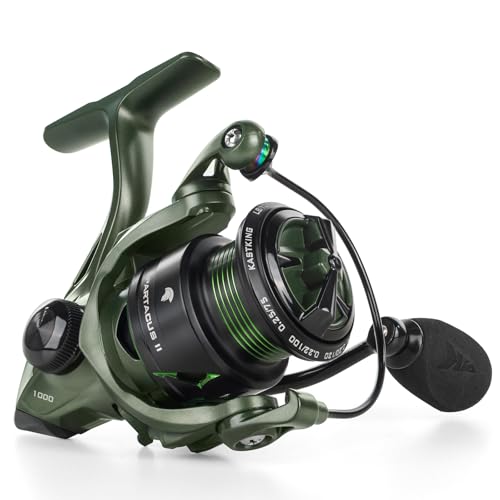
Budget spinning reels—your KastKing Spartacus II, Centron, and HANDING models in the $30–$80 range—get you wet without breaking the bank. They're engineered for volume, not longevity. The frame is usually lightweight aluminum or reinforced plastic, which keeps weight down and cost lower. The spool spins freely on entry-level bearings that look fine on paper but don't maintain precision after a few months of saltwater spray and temperature swings Lake Erie throws at you.
The real weakness lives in the drag system. Budget reels use felt-based or basic composite drag washers that absorb moisture and stiffen in cold water. Cast in November, and you'll feel the difference—that drag that felt silky smooth in August now sticks and slips erratically when you set the hook on a cold-water bass. The sealed drag systems on budget reels are marketing speak; they're not truly sealed against Lake Erie's conditions. Bearing corrosion sneaks in through the bail and rotor, and within two seasons, the reel's smoothness is gone.
That said, budget reels excel as backups or teaching tools. You're not gambling your tournament if your spare reel fails. For casual summer bass fishing on protected flats, they'll get you through the season. The KastKing Spartacus II actually holds up better than most in its price class because the sealed carbide (not just marketing—actual sealant) provides slightly better protection. But the moment you expect year-round performance, you're asking too much.
About Premium Reels for Lake Erie Bass Fishing
Premium reels—Sougayilang models with 12+1 ball bearings, HANDING LITE II, and equivalent quality pieces—start at $150 and climb toward $400. The difference isn't just engineering; it's physics. Premium reels use multi-disk sealed drag systems with stainless steel washers and advanced materials that maintain drag feel across 40-degree temperature swings. Cast your premium reel in fall and spring, and the drag responds the same way every time. That consistency is why tournament bass anglers trust premium gear.
The bearing quality separates premium from budget immediately. A high-end reel carries 11–14 premium stainless steel bearings versus a budget reel's 3–5 marginal ones. More bearings mean smoother line flow, less friction, and longer cast distances with the same rod and technique. The machined aluminum spool on premium reels sits rock-solid under load; budget reels develop wobble that accelerates line wear and reduces casting accuracy.
Sealed components define premium durability on Lake Erie. The bail, rotor, and drag housing on quality reels resist corrosion and salt creep. You can fish November through March without panic-cleaning your reel every session. That's not laziness—it's efficiency. A premium reel demands maintenance, but it forgives neglect far better than budget gear. Buy a premium reel now, and you're buying 5–8 seasons of reliable bass fishing. Buy a budget reel, and you're buying 1–2 seasons of decent performance before drag failure or bearing wear forces replacement.
Head-to-Head: Drag Performance Under Cold Water and Load
This is where Lake Erie bass fishing gets real. You're pitching a finesse jig to a drop-off in November. Water temp is 48 degrees. A big largemouth—solid 4 pounder—crushes your offering and runs toward deeper water. Your drag needs to slip smoothly without stalling or jerking. Budget reel drags fail this test. The felt washers in cheap reels absorb moisture throughout the season, and cold water makes that moisture sluggish. Your drag doesn't slip evenly; it sticks, then gives, then sticks again. You lose fish. Your angler friend with the premium reel lands the same bass because the sealed multi-disk drag maintains consistent tension whether the water is 70 or 45 degrees.
Premium reel drags also hold pressure better under sustained load. When you're fighting a bass in wind-churned Central Basin water, you're applying steady pressure for 30–45 seconds sometimes. Budget reels' drag systems heat up and lose adjustability; the washers can even slip off-center if drag tension is high. Premium systems absorb that heat without changing performance. You turn the drag knob and feel immediate response. On a budget reel, that same turn might feel vague because the internal components aren't as precisely machined. This isn't opinion—it's mechanics. Better materials, tighter tolerances, superior performance.
Head-to-Head: Bearing Quality and Casting Distance
Bearing count matters, but bearing quality matters more. A premium reel's 12 stainless steel bearings with tighter tolerances let your spool rotate faster and more efficiently than a budget reel's 4 basic bearings. That translates directly to casting distance. With identical rod and technique, you'll cast 8–12 feet farther with a premium reel because less friction means the spool maintains speed longer. When you're working shallow flats or trying to reach schooling bass on the edge of weed lines, that extra distance changes strike rates.
Bearing corrosion also accelerates on budget reels. Lake Erie's spray and humidity corrode inferior bearings quickly. By mid-season, bearing wear causes play in the rotor, which creates micro-vibrations you feel as a slight grinding sensation. Premium bearings resist corrosion significantly longer, and sealed bearing housings on high-end reels virtually eliminate salt creep. You'll feel the smoothness of a premium reel for years. A budget reel loses that smoothness within months.
Head-to-Head: Maintenance Demands and Actual Cost of Ownership
Budget reel marketing claims "low-maintenance," but reality is harsher. You actually need to service budget reels more frequently because corrosion sneaks in faster and bearing wear accelerates. You're looking at detailed cleaning and re-lubing every 8–12 fishing days during season. Skip that, and bearing play develops within a month. Premium reels tolerate longer intervals between services—you can fish 20–30 days between proper maintenance. That saves hours per season. If you factor in the cost of replacement bearings, drag washers, and your time, a budget reel's low purchase price erodes quickly.
Real ownership cost tells the true story. A $50 budget reel that lasts 18 months of regular use costs $33 per month. A $200 premium reel that lasts 60 months costs $3.33 per month. Add maintenance supplies, and that gap closes even further in the premium reel's favor. Tournament anglers understand this math; casual anglers often don't. If you fish Lake Erie seriously, premium reels pay for themselves within three seasons.
Head-to-Head: Spool Design and Line Capacity
Premium reels feature machined aluminum spools with tighter tolerances. The spool seat holds perfectly true, meaning line lays evenly across the spool with zero wobble. Budget reels use lighter materials and looser specs;
Frequently Asked Questions
How do I choose between a budget and premium spinning reel for Lake Erie bass fishing?
Consider your fishing frequency and budget—budget reels work well for occasional anglers, while premium reels offer better drag performance and durability for regular lake fishing in cold water conditions. Premium reels maintain consistent drag performance under load and in Lake Erie's cold temperatures, which is crucial for landing trophy bass without line breaks.
What is the best spinning reel for cold water bass fishing on Lake Erie?
Premium spinning reels are specifically engineered to maintain smooth drag performance in cold water conditions where budget reels may freeze or perform inconsistently. Look for reels with sealed drag systems and corrosion-resistant materials designed for freshwater lake environments.
Is it worth investing in a premium spinning reel for bass fishing?
Yes, if you fish Lake Erie regularly—premium reels provide superior drag performance under load, better reliability in cold water, and greater longevity, which saves money on replacements over time. Budget reels are only recommended if you fish occasionally or are testing the hobby.
How does drag performance differ between budget and premium spinning reels in cold water?
Premium reels maintain consistent, smooth drag even in Lake Erie's cold temperatures, while budget reels can experience drag inconsistency or stiffness when exposed to prolonged cold conditions. This difference is critical when fighting large bass to prevent line breakage and lost catches.
What should I look for in a spinning reel for Lake Erie fishing?
Prioritize corrosion resistance (sealed drag systems), reliable drag performance under heavy loads, and smooth operation in cold water conditions. Check that the reel handles Lake Erie's demanding conditions with quality ball bearings and materials designed for freshwater saltwater-adjacent environments.
How do I know if my spinning reel needs replacing for Lake Erie bass season?
Signs include inconsistent drag performance, difficulty turning the handle, visible rust or corrosion, or reduced casting distance. If your current reel struggles in cold water or under load, it's time to upgrade to a reel specifically tested for Lake Erie conditions.


