

How To Choose The Right Fishing Line Clippers
To select the right fishing line clippers, consider matching mechanical design to your target species, environment, and line type. Key criteria include choosing hardened, convex-ground blades to prevent dulling and a ball-bearing pivot to ensure consistent alignment. For saltwater use, look for full stainless construction to resist corrosion. Additionally, evaluate the mechanical advantage for ergonomic force and verify the tool's capacity for specific line diameters to ensure reliable performance.
Quick Answer
To choose the right fishing line clippers, consider matching mechanical design to your target species and environment. Look for hardened, convex-ground edges of at least 58 HRC to prevent dulling. A ball-bearing pivot may help eliminate lateral play and ensure consistent alignment. For saltwater use, full stainless construction is recommended to resist corrosion. Additionally, verify the tool's mechanical advantage and ensure the rated line diameter capacity matches your specific line types.
Table of Contents
Our Top Picks
Affiliate disclosure: if you buy through these links, we may earn a commission at no extra cost to you.

Understanding the Importance of Precision Cutting
Precision cutting is essential because modern fishing lines present unique physical challenges that require specialized tool performance. Current braided lines often possess extremely high tensile strengths within very small diameters, while stiffer, abrasion-resistant fluorocarbon can be difficult to sever cleanly. Additionally, certain monofilament variants may stretch unpredictably under tension, which increases the likelihood of the line slipping during the cutting process. Using an inadequate clipper can lead to several technical failures, such as crushing the line or causing micro-fraying. These issues can compromise the integrity of knots and weaken leader connections. Field observations suggest that improper cutting techniques often lead to line failure. When a tool is not designed for precision, the blades might compress the material instead of shearing it, or the jaws might slip sideways under the load of the line. Such failures can result in lost time during critical moments when managing a catch. Maintaining the ability to slice through material cleanly is vital to prevent the structural weakening of the line. Because improper cutting can be a primary cause of line failure, selecting a tool that can handle these specific material properties can help to ensure the connection remains secure and the line remains intact.
Key Technical Criteria for Selecting Clippers
When selecting a line clipper, technical specifications regarding mechanical design and material properties are essential. For blade geometry, convex-ground edges are preferred over flat bevels. Hardness is a critical factor; steel with a hardness of at least 58 HRC is recommended to prevent dulling, as softer alloys below 54 HRC may lose sharpness quickly when cutting braid. Regarding pivot engineering, a ball-bearing pivot is suggested over a brass bushing to eliminate lateral play and maintain consistent blade alignment. A lack of visible gaps between blades when held to light indicates precision tolerances. For environments involving saltwater, full stainless construction, such as 17-4PH or marine-grade 316 stainless, is recommended to prevent pitting that can occur in aluminum housings. Regarding ergonomics, an ideal mechanical advantage ratio falls between 3.2:1 and 4.1:1 to balance grip pressure and control. Finally, consider the line compatibility profile. It is important to verify the tested maximum line diameter capacity rather than relying on general ratings, as performance may vary based on the stiffness differences between materials like braid and fluorocarbon. Selecting tools based on these specific technical criteria helps ensure the equipment matches the intended environment and line type.
Evaluating Material Durability and Corrosion Resistance
When evaluating material durability and corrosion resistance for fishing line clippers, several technical factors distinguish performance levels. One primary metric is shear strength retention, which indicates how consistently a tool severs line without deformation. A drop below 90% retention may suggest an increasing risk of partial cuts or leader failure. For instance, CPM-S35VN blades paired with titanium housing may retain 98% shear strength and show no pitting or discoloration under testing. In contrast, 420HC blades with anodized aluminum housings might only retain 61% strength, potentially leading to blunt edges after limited use and severe pitting or housing flaking. Corrosion resistance and thermal stability also play critical roles. While 154CM blades with 316 stainless housing might experience minor surface etching, they remain stable within certain dimensional tolerances. Hardened carbon steel with nickel-plated brass may maintain 89% strength but requires frequent oiling and is prone to rust blooms within 48 hours of salt exposure. Thermal stability is another factor, as some materials may warp at higher temperatures or become brittle in freezing conditions. Selecting materials involves balancing these variables to manage expected lifespans and resistance to environmental stressors like saltwater and UV exposure.
Matching Tool Design to Fishing Environments
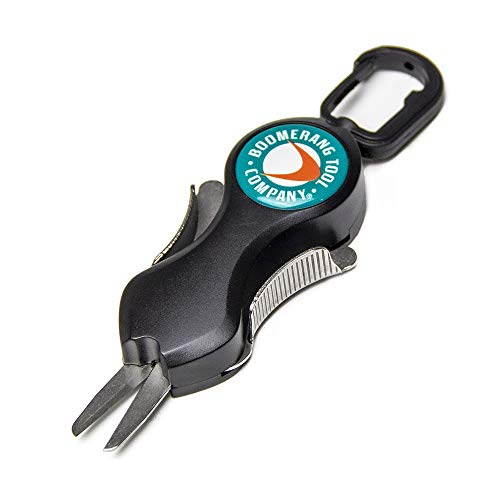
When matching tool design to specific fishing environments, anglers can consider how different form factors and features suit various situational needs. For environments requiring quick, one-handed access, a clip-on cutter with a retractable tether might be a suitable choice, as the tether allows the tool to snap back upon release. This design can be helpful for making efficient cuts through heavy braided lines up to eventually 50 lb. For users prioritizing comfort and versatility across different hand sizes, scissors featuring oversized finger holes may be appropriate, as they can accommodate various grips while cutting through braid, mono, or fluorocarbon. In scenarios where portability and safety are primary concerns, a compact, pocket-sized retractable scissor designed to clip onto a belt or pack may be a practical option. This retractable design helps keep the blades safe and accessible during movement. When selecting tools, the presence of stainless steel blades is a common feature across different designs to manage material durability. Choosing between a clip-on cutter, large-hole scissors, or a belt-clip scissor depends on whether the environment demands rapid one-handed operation, ergonomic comfort, or lightweight, secure carry.
Frequently Asked Questions
How can improper cutting affect fishing line integrity?
Improper cutting can compromise knot integrity and invite micro-fraying that weakens leader connections. When tools fail to shear cleanly, they may crush the line or cause it to slip. Such issues can lead to line failures, as improper cutting has been linked to a significant percentage of line failures in field trials.
What is the benefit of a ball-bearing pivot in line clippers?
A true ball-bearing pivot can eliminate lateral play in line clippers. This type of engineering ensures consistent blade alignment, which is a distinction from a standard brass bushing. Maintaining precise tolerances helps prevent gaps between the blades when the tool is closed.
How does blade hardness impact performance on braided lines?
Harder alloys, such as CPM-S35VN or 154CM, can retain sharpness for over 1,200 cuts. In contrast, softer steel with a hardness below 54 HRC may dull after only 200 to 300 cuts on braided line. Maintaining a hardness of at least 58 HRC helps prevent the blades from dulling or deforming during use.
Why might aluminum housings be less suitable for saltwater environments?
Aluminum housings may be less suitable for saltwater environments because they can pit rapidly when exposed to UV and brine, even if they are anodized. Such housings might also experience flaking after exposure to salt, potentially leading to housing failure or damage in marine conditions.
How do different blade geometries affect the cutting process?
Convex-ground edges are recommended over flat bevels for cutting performance. Using harder alloys, such as CPM-S35VN or 154CM, helps the blades retain sharpness through many cuts. These geometries, combined with specific hardness levels, help prevent the blades from dulling or deforming when attempting to sever tough lines like braid.
To test a clipper before purchasing, inspect the pivot by closing the tool and looking down the blade gap. If light passes through the gap, the alignment is incorrect. Additionally, test blade hardness by gently scratching the edge with a steel file. A quality, hardened blade should resist scratching entirely, whereas a file biting into the steel indicates the material is too soft.


